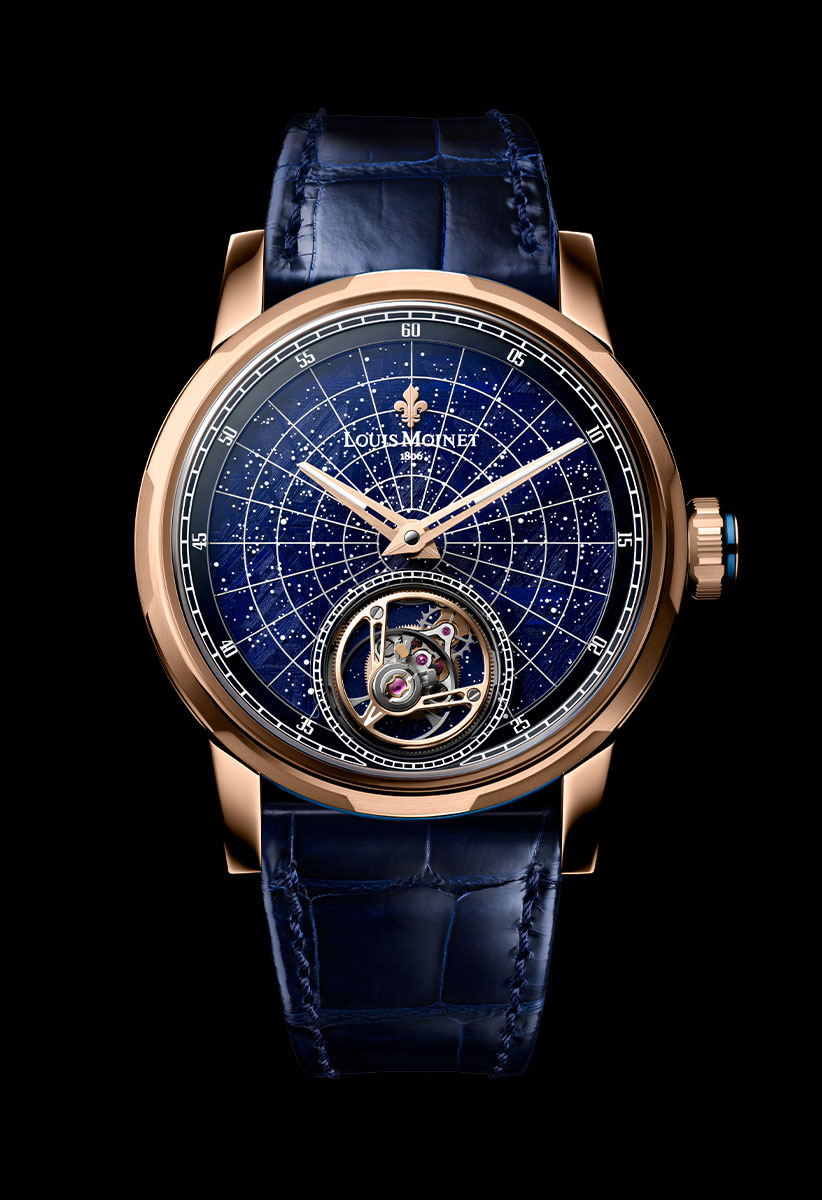

LM-180.40.25
Time in the cosmos












“STELLARIUM is defined as a space dedicated to the stars. Together with the Louis Moinet Technical Laboratory, we conceived this timepiece as a universe to be explored. Its many details reveal themselves gradually. Indeed, the STELLARIUM offers many surprises and a few secrets as well.”
Nathanaël Schaller

A meteorite formed nearly 4.5 billion years ago and numbers among the oldest meteorites discovered on Earth. It reveals fascinating Widmanstätten patterns.
In the background, the Muonionalusta meteorite is bathed in a deep midnight blue. Formed nearly 4.5 billion years ago, at the dawn of the solar system, it is thought to have fallen to Earth around one million years ago in northern Sweden. Inside are the famous Widmanstätten patterns, natural geometric designs formed by extremely slow cooling. For the STELLARIUM, the meteorite was dyed a deep blue using a process that is complex and has been kept secret. This extraterrestrial mineral, which acts as a link between the cosmos and the timepiece’s mechanism, is also used as a backdrop to the tourbillon cage.
The sense of depth in the STELLARIUM dial is achieved through a particularly ingenious design. Composed of several layered elements, it notably combines this meteorite with a transparent sapphire disc.
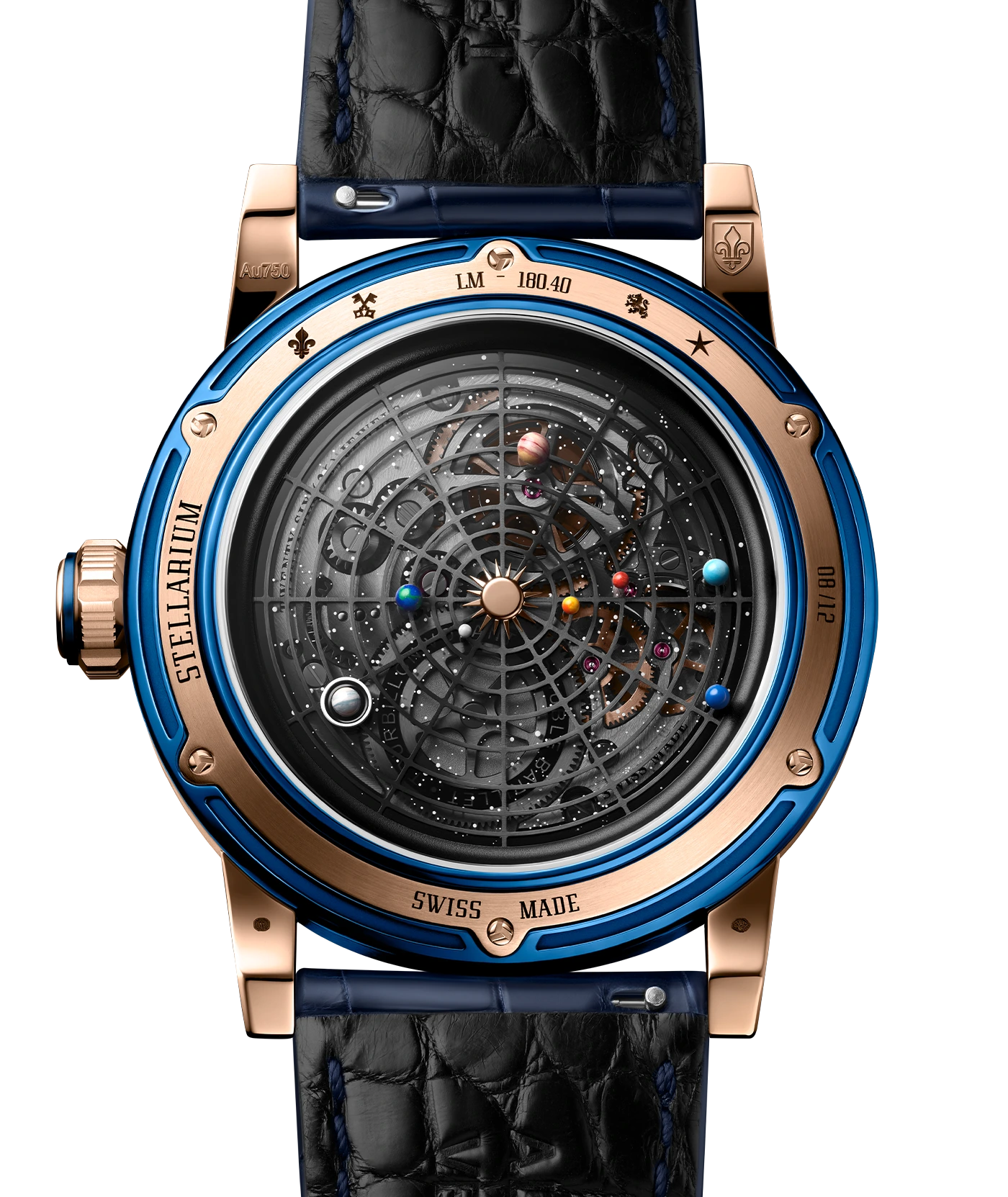
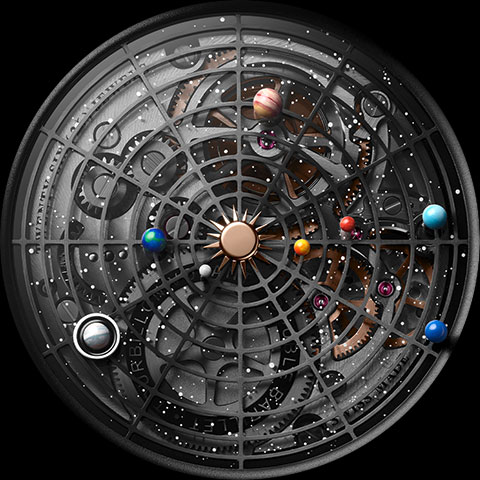
The ultimate secret can now be revealed: the planets are positioned according to their exact configuration on 21 March 2013, the day the world of watchmaking learned of a major historical milestone. On that day, at the Neuchâtel Observatory, Jean-Marie Schaller unveiled the famous Compteur de tierces, created in 1816 by the great watchmaker Louis Moinet, which turned out to be the first chronograph ever made.
However, this date is merely one possibility for the planets’ positioning. On request, they can also be arranged to show a date chosen for its special significance. It is a unique way of immortalising a moment that matters to its owner in the heavens.
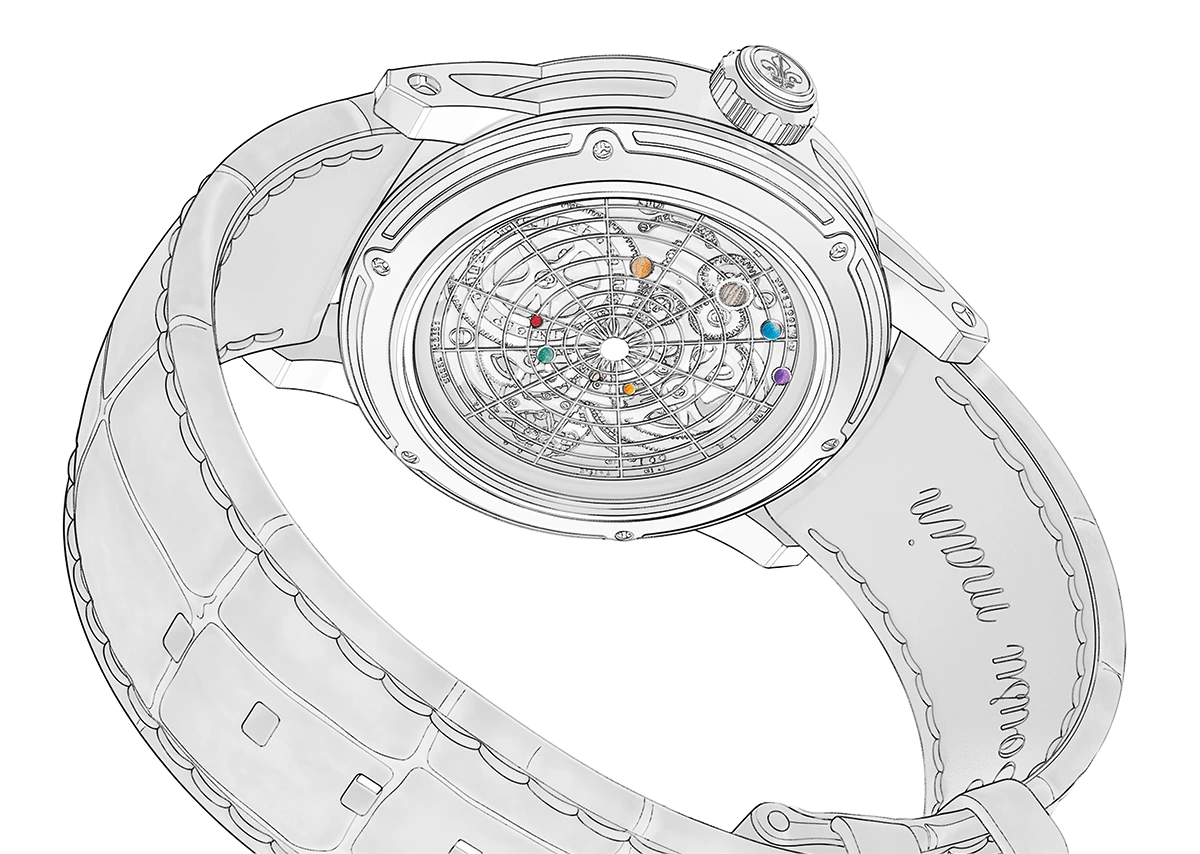
The STELLARIUM case stands out for its clean lines and highly technical construction. Its openworked sides reveal a blue, DLC-coated titanium core housing the movement. This structure is inside a red-gold frame made up of four separate elements that are ingeniously assembled. The curved sapphire crystal further accentuates the depth of the overall design.
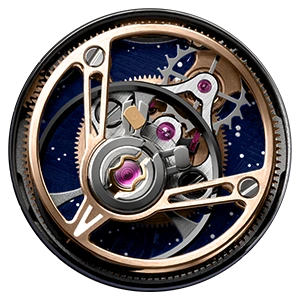
The STELLARIUM features a flying tourbillon with an off-centre cage that appears to defy gravity in a captivating manner. The hand-wound movement is powered by two serial spring barrels that are arranged head-to-tail using the "volte-face" system. It provides a generous power reserve of 96 hours.


